On March 29, 2023, Small Island Developing States (SIDS) took a historic climate case to the International Court of Justice (ICJ), seeking a ruling on states' legal duties to combat climate change. With unprecedented global participation, this case could reshape climate law and accountability worldwide.
What is the International Court of Justice (ICJ), and what role does it play?
The International Court of Justice (ICJ) is the principal judicial organ of the United Nations (UN), established in 1945 and headquartered in The Hague, Netherlands. It serves two primary functions:
The ICJ plays a critical role in shaping international legal norms by interpreting treaties, clarifying state obligations, and reinforcing legal principles that govern state behavior. While it does not have enforcement power, its rulings and advisory opinions are often used as legal precedents in international negotiations, domestic courts, and future treaties.
What is an advisory opinion, and who is authorized to request one?
An advisory opinion is a formal legal interpretation issued by the ICJ at the request of UN bodies or international organizations. Unlike rulings in disputes between states, advisory opinions are not legally binding, but they hold significant weight in shaping international law and policy.
The following UN bodies are authorized to request an advisory opinion:
What are Small Island Developing States (SIDS), and why are they at the center of this case?
Small Island Developing States (SIDS) are 39 states and 18 associate members recognized by the UN as particularly vulnerable to economic, social, and environmental challenges. These states are spread across:
Though SIDS represents less than 1% of the world’s population (approx. 65 million people), they face some of the most severe consequences of climate change, including:
Who initiated this case, and how did it reach the ICJ?
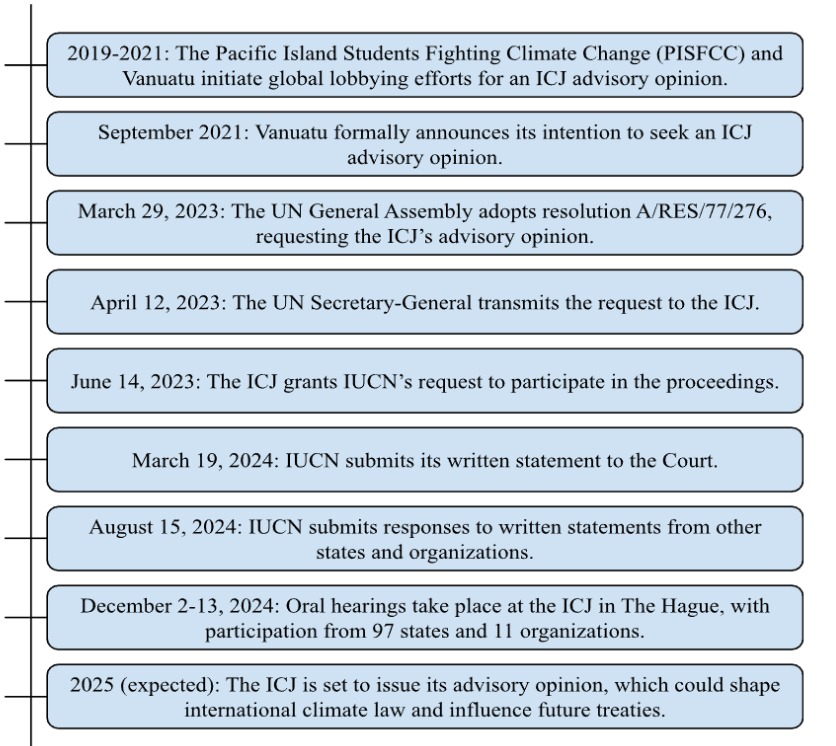
The legal push for this case began with Pacific Island Students Fighting Climate Change (PISFCC). In 2019, a group of 27 students from the University of the South Pacific came together to begin a campaign to persuade the leaders of the Pacific Islands Forum to take the issue of climate change and human rights to the International Court of Justice, urging their governments to seek an ICJ advisory opinion on climate change obligations under international law. In September 2021, Vanuatu, along with 18 other nations, drafted a UN General Assembly (UNGA) resolution requesting the ICJ’s opinion on states’ legal duties regarding climate change.
What is the primary legal issue in this case?
This case seeks to determine:
SIDS argue that climate change is not just an environmental issue but a matter of legal responsibility, as states have a duty under international law to protect vulnerable populations, which the treaties alone do not meticulously specify.
Which parties are involved in this case?
Timeline of the Case
Why is this case considered a historic moment in international law?
This case represents the first time in history that the ICJ has been asked to define states' legal responsibilities regarding climate change. It has drawn participation from 96 countries and 11 international organizations, making it the largest climate-related legal proceeding ever held.
The ruling could fundamentally reshape climate accountability, influencing future treaties, legal actions, and international relations.
Has there been a similar case before?
In 2024, the International Tribunal for the Law of the Sea (ITLOS) ruled that states must control greenhouse gas emissions under maritime laws. However, the ICJ case is far broader, addressing global legal responsibilities beyond maritime concerns.
What is the stance of major global powers?
How could this ruling affect India specifically?
India is both a major emitter of greenhouse gases and highly vulnerable to climate change, facing rising temperatures, water shortages, and extreme weather events. A strong ICJ ruling could:
What impact can an ICJ advisory opinion have on global climate governance?
While an advisory opinion does not impose direct legal obligations, it can:
This ICJ case is not just a legal debate—it is a turning point in international climate governance. If the ICJ delivers a strong advisory opinion, it could:
For Small Island Developing States, this case is about survival. For the rest of the world, it is a clear signal that climate inaction may soon come with serious legal consequences. The ICJ’s decision will be one of the most significant legal milestones in climate justice history.
Homita Ganguly is a final-year student at Christ (Deemed to be University), pursuing BSc in Economics and Analytics. She is currently working as a Research Analyst Intern at The Analysis.
TA is a Bhopal-based policy and development consulting group. We are on a mission to make the development space more inclusive and democratic for students and professionals. Join us on this mission.