On August 6, the Yale Program on Climate Change Communication (YPCCC), part of the Yale School of the Environment, unveiled its latest study: the Climate Opinion Maps for India. This project marks a significant advancement in understanding climate attitudes across the country, providing detailed, region-specific insights that were previously lacking. Previous studies offered a broad national overview but lacked regional detail.
YPCCC's analysis addresses this gap, translating national data into detailed insights at the state and district levels. The new tool provides estimates of climate opinions in 34 of India’s 36 states and Union territories and 604 districts, offering a granular view of variations in global warming knowledge, beliefs, risk perceptions, and policy preferences.
Grounded in data from large-scale surveys conducted between October 2021 and January 2022 and September 2023 to November 2023, YPCCC’s interactive maps visualize variations in climate knowledge and policy support across 34 states and 604 districts, enhancing the precision of public opinion estimates and highlighting regional differences.
The research reveals important insights into climate perceptions across India. Nationally, 41% of Indians report being knowledgeable about global warming, with significant regional variations. For instance, 52% of respondents in Gujarat are informed, while in Maharashtra, only 33% are. Residents of state capitals tend to have greater awareness than other districts, underscoring the uneven distribution of climate knowledge.
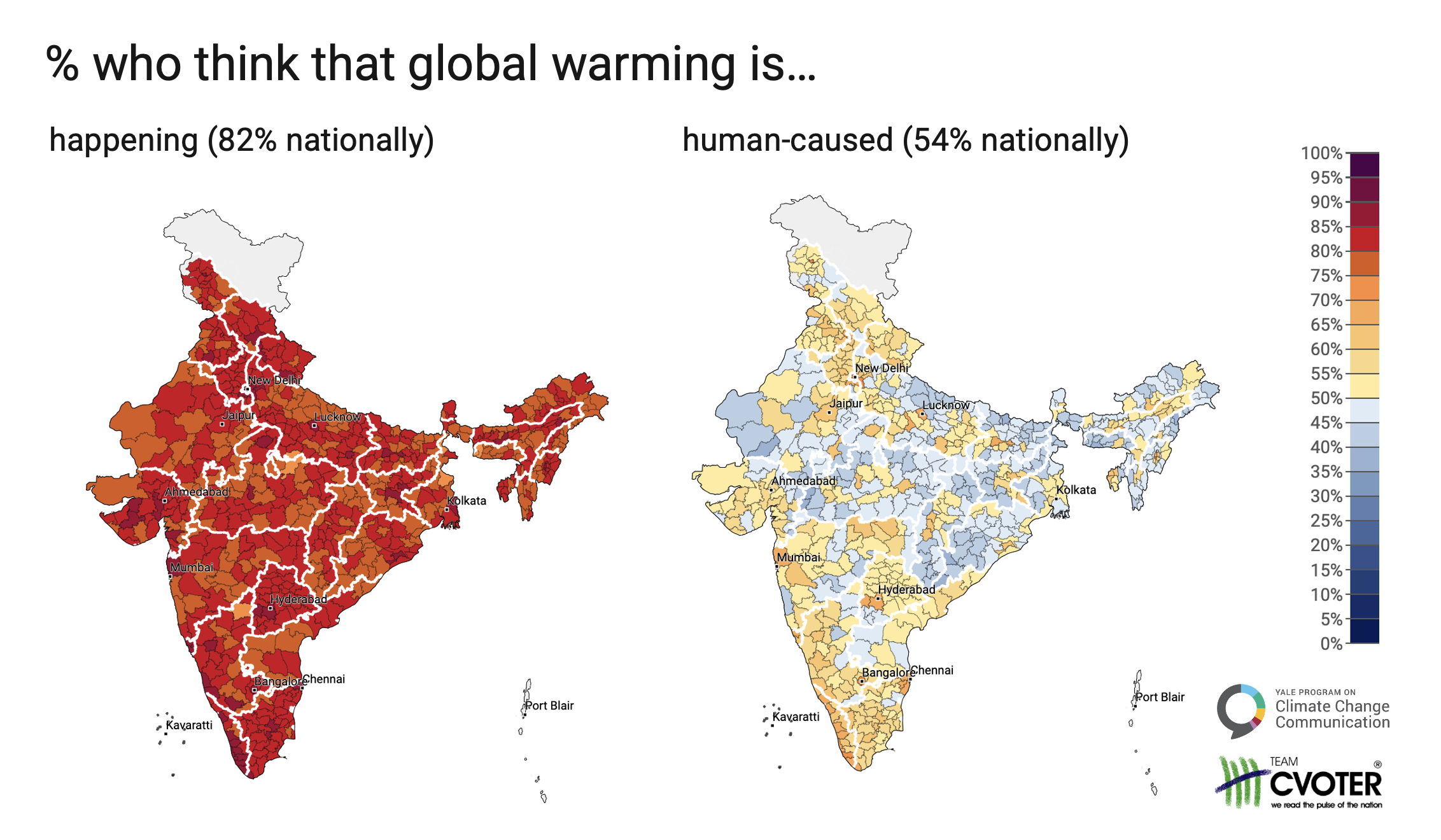
Further analysis shows that 82% of Indians believe global warming is occurring. However, only 54% attribute it to human activities. This indicates a notable gap from the international scientific consensus, which widely agrees that human activities, such as burning fossil fuels and deforestation, are the primary drivers of global warming. This gap suggests that while many people recognize the reality of global warming, there is less understanding or acceptance of its human-induced causes, reflecting a divergence from the broader scientific agreement.
In Thiruvananthapuram, Kerala, 68% recognize global warming is human-caused, while in Kheri, Uttar Pradesh, only 43% do. These variations highlight the need for targeted communication strategies to address diverse regional understandings.
Risk perceptions of global warming are relatively consistent, with 85% of Indians expressing concern. Yet, states like Kerala, Goa, and Punjab report higher perceived risks compared to Karnataka and Tamil Nadu. Regional differences reflect varying climate impacts, with droughts being a major concern in the northwest, flooding in the east, and cyclones, droughts, and water shortages prevalent in the south.
Despite these differences, most Indians across all states anticipate more severe climate events, including cyclones, droughts, and food shortages. Concerns about plant and animal extinctions are also widespread (70%), along with fears of increased famines and food shortages (64%).

Support for climate policies shows regional variation as well. Nationally, 58% of Indians support reducing fossil fuel use, with the highest support in Haryana (70%) and the lowest in Andhra Pradesh (37%). Similarly, 59% favor increasing renewable energy use, with strong backing in Goa and Kerala (72%) and weaker support in Assam (41%).
| Climate Opinions in Madhya Pradesh In Madhya Pradesh, 78% of residents report having personally experienced global warming. While 41% are well-informed about the issue, 55% know little or nothing. About 54% believe global warming is caused by human activities, whereas 38% do not share this view. There is strong support for climate action, with 59% advocating for increased use of renewable energy and reduced reliance on fossil fuels. Despite this, 85% express concern about global warming, while 10% remain indifferent. |
These insights from YPCCC are crucial for Indian policymakers and climate advocates, offering a detailed understanding of regional variations in climate attitudes. Such data helps tailor climate strategies to address specific local concerns, making them more effective. As India gets ready to revise its national, state and district level climate action plans, such localized insights become crucial.
In regions with lower awareness or differing perceptions, targeted educational campaigns and policy adjustments can play vital role in educating the communities about climate change. By doing so, climate policies can become more relevant, effectively increasing public support and driving meaningful climate action.
Overall, these findings underscore the importance of a nuanced understanding of climate attitudes across diverse regions of India. By incorporating this localized data into policy development, India can craft more effective and resilient climate strategies, ultimately enhancing the country's ability to tackle the global climate challenge.
Diya is a research associate at TA. She is a recent graduate in economics.
TA is a Bhopal-based policy and development consulting group. We are on a mission to make the development space more inclusive and democratic for students and professionals. Join us on this mission.