A research study exploring employment opportunities, emerging sectors and skill requirements to identify pathways towards decent work and economic empowerment for marginalised women in India.


The Analysis conducted a comprehensive research project for the US-based Nomi Network to map the national employment landscape for marginalized women workers in India, with a focus on women from low socioeconomic backgrounds and with limited formal education. The study also looked at employment opportunities in the new and emerging sectors such as clean energy, digital technology, automation and AI.
The study examined the employment landscape to identify where opportunities exist, what skills are increasingly required, and what pathways could connect women to decent work, livelihoods, and economic empowerment.
The research looked across both formal and informal employment sectors to understand the kinds of work available to women from vulnerable backgrounds and the skills needed to access them.
It also explored how migration, changing sectoral demand, and technological shifts may influence women’s employment opportunities in the coming years. Particular attention was given to emerging sectors, projected growth through 2030, and the potential impact of AI on the nature and availability of jobs.
The study further mapped livelihood-development organisations, ethical recruitment entities and self-employment pathways, helping identify the ecosystem of support and employment linkages available to women beyond conventional job placement.
While the research identified broader national patterns, it also examined Bihar, Jharkhand, West Bengal and Odisha in greater detail.
This state-level analysis helped identify differences in employment opportunities, migration destinations, sectoral trends, support organisations and potential livelihood pathways, providing a more grounded understanding of where interventions could be most relevant.
The study followed a systematic literature review methodology, bringing together evidence from academic research, government databases, international development agencies, and civil society organizations.
Sources included datasets and publications from institutions such as the NSSO and Ministry of Labour, alongside research and programme insights from organisations including PRADAN and SEWA, and international institutions such as the ILO, UN Women and World Bank.
The research team used structured screening and thematic coding to synthesise findings, identify patterns and highlight gaps across the employment landscape.
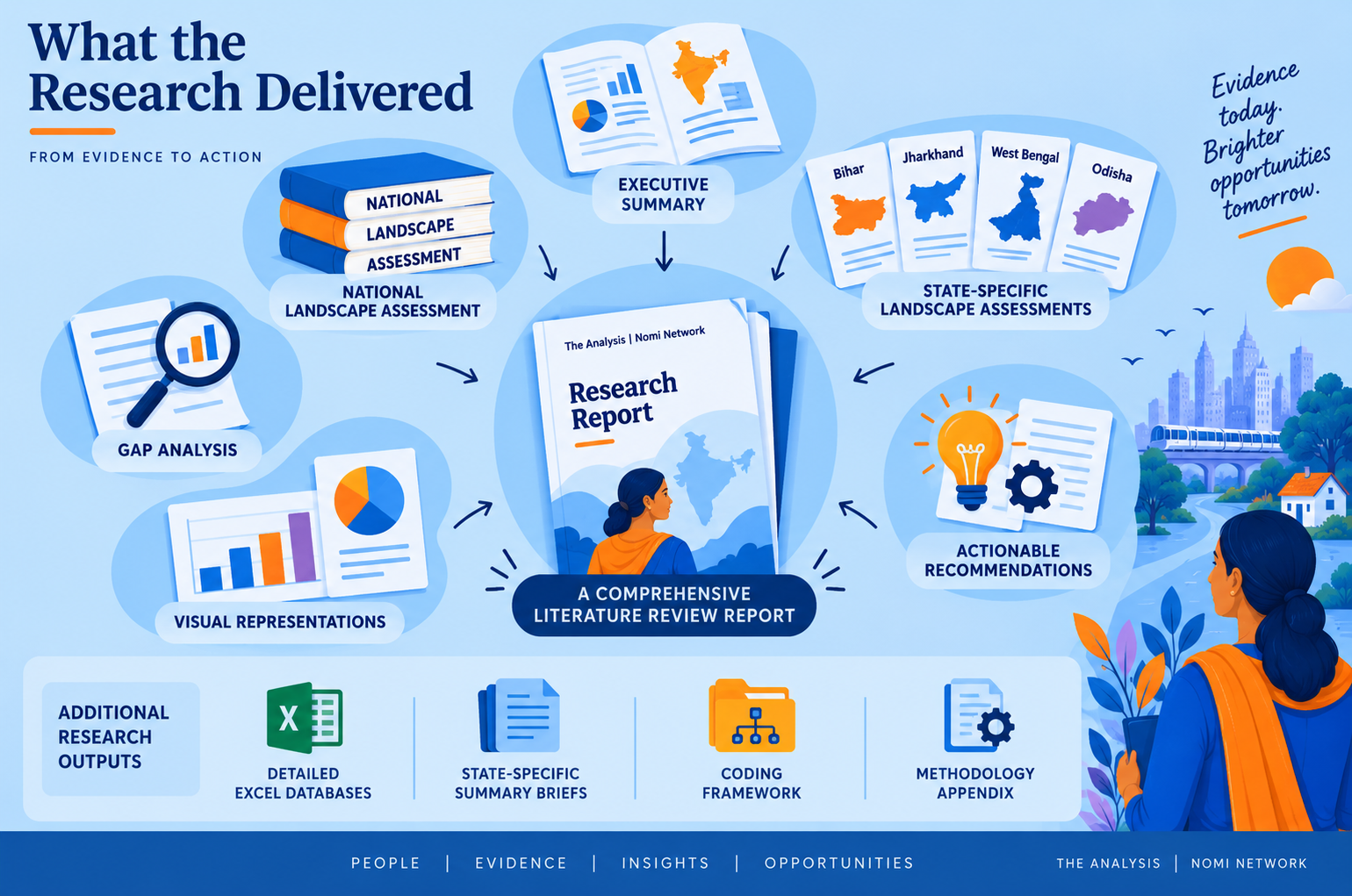
The study resulted in a comprehensive literature review report bringing together an executive summary, national and state-specific landscape assessments, gap analysis, visual representations and actionable recommendations.
The research was also supported by detailed Excel databases, state-specific summary briefs, a coding framework, and a methodology appendix documenting quality assurance measures.
The study provides a foundational evidence base for Nomi Network’s work in India to design evidence-based programmes that connect marginalized women with decent work and livelihood opportunities in states like UP, Jharkhand, West Bengal, and Odisha.
By mapping where employment is growing, what skills are needed, how women access opportunities, and where gaps remain, the research helps inform pathways towards skills development, employment linkages and economic empowerment across India’s formal and informal employment sectors.