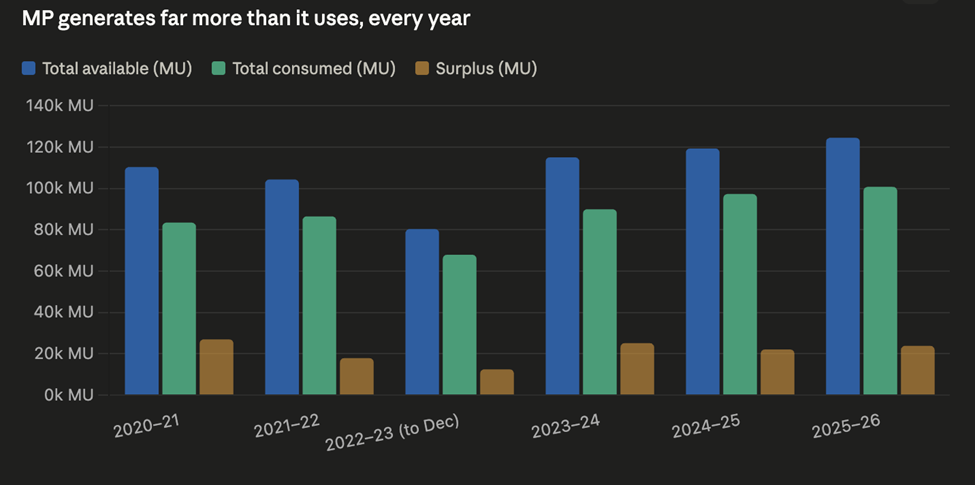
Every month, electricity bills arrive in homes and factories across Madhya Pradesh—and every year, they get a little higher. This would make sense if the State were short of power. But it is not. Madhya Pradesh is officially a power-surplus State. So why are consumers paying higher electricity bills for power the State does not even use?
The answer lies not in the power plants, but in the contracts behind them.
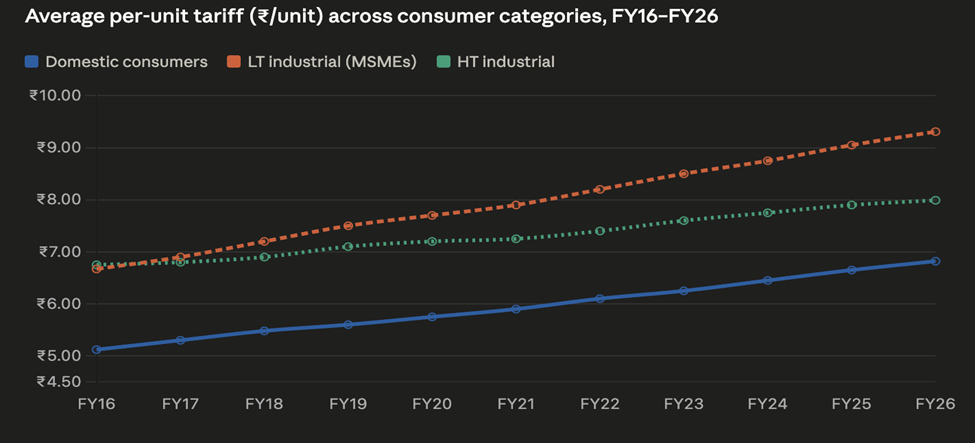
According to tariff data from Madhya Pradesh electricity regulatory commission (MPERC), Madhya Pradesh has generated surplus power every year between 2020 and 2026. In 2025–26 alone, the state recorded a surplus of nearly 23,795 million units (MU) of electricity. Over the same period, domestic electricity tariffs increased by approximately 33%, while industrial tariffs rose by nearly 40%. Urban consumers using 500 units of electricity a month now pay about 68% more than they did in 2010.
This is not a story about energy scarcity. It is a story about contract design—and who bears the cost when those contracts go wrong.
At the heart of the problem are long-term Power Purchase Agreements (PPAs)—contracts between the State's power management company (MPPMCL) and electricity generators, typically spanning 25 years or more. These are structured as 'take-or-pay' agreements, requiring the State to pay a fixed 'capacity charge' to the generator whether or not it draws any electricity.
Between 2015–16 and 2025–26, Madhya Pradesh paid ₹3,316 crore in capacity charges for electricity it never consumed. In 2020–21 alone, that figure reached ₹927 crore. The money did not buy a single unit of electricity. It simply paid for generating capacity that the State did not need.
These costs do not disappear. They are recovered through higher electricity tariffs, ultimately passed on to every household and factory in the State.
The problem is compounded by timing. A significant share of Madhya Pradesh's renewable energy PPAs was signed between 2014 and 2016, when solar and wind tariffs ranged between ₹5 and ₹6 per unit. Today, the same power can be procured through competitive bidding for around ₹2–2.5 per unit. Yet DISCOMs remain locked into these long-term contracts for another decade or more, preventing them from switching to cheaper alternatives.
The challenge is not limited to renewable energy. Two thermal PPAs signed with Adani Power—the 1,320 MW Pench project (2020) and the 1,600 MW Anuppur project (2025)—illustrate the scale of the financial commitments involved. Together, these two agreements are estimated to create annual fixed-cost liabilities of around ₹6,650 crore, regardless of whether the electricity is consumed. Over their 25-year tenure, this amounts to an estimated ₹1.66 lakh crore in fixed payments.
The government often points to surplus power sales on energy exchanges as evidence that the system is working. The numbers tell a different story. In 2025–26, Madhya Pradesh sold about 9,518 million units (MU) of surplus electricity on energy exchanges, generating ₹4,334 crore in gross revenue. But after accounting for variable energy costs, the net savings amounted to just ₹714 crore. Meanwhile, fixed charges continued to accumulate on the remaining unused capacity.
Selling surplus power recovers only a fraction of the variable costs. It does nothing to reduce the fixed-cost liabilities built into long-term contracts. The surplus itself is the symptom—it should not have existed in the first place.
Madhya Pradesh's electricity governance requires urgent course correction. New long-term PPAs—especially those with large private generators—must be assessed against realistic demand projections. Regulatory mechanisms for contract renegotiation and exit should be strengthened, and MPERC's oversight of procurement decisions by MPPMCL must be enhanced to ensure that DISCOMs are not burdened with liabilities they had no role in creating.
Madhya Pradesh's consumers—urban, rural, and industrial—are not paying higher electricity bills because power is scarce. They are paying because the State entered into long-term contracts that transferred much of the financial risk to consumers. That is the paradox. Unless procurement policy changes, electricity bills will continue to rise—even in a State with surplus power.
(The views expressed in this article are solely those of the author)
Raj Pratap Singh is a policy researcher who served as a Research Associate in Bhopal for six months, studying Madhya Pradesh's DISCOMs and the State's healthcare system.
TA is a Bhopal-based policy and development consulting group. We are on a mission to make the development space more inclusive and democratic for students and professionals. Join us on this mission.