Proposed in the 1980s, the Ken-Betwa River Interlinking Project aims to transfer surplus water from the Ken River in Madhya Pradesh to the Betwa River in Uttar Pradesh. This project, envisioned to help solve the drought problem in Bundelkhand, is the first of the thirty river interlinking projects in India, as proposed under the National Perspective Plan.
However, the project has raised several questions and concerns regarding the loss of biodiversity at the Panna Tiger Reserve, displacement caused by the dam's construction, and the impact on the atmosphere with the reduction in rainfall.
The local communities fear losing their land and getting displaced. A forty-year-old Kala from Dhaudhan village, while speaking to media, expressed her agony with the words, “Leaving one’s land is painful. Who would want to go? Even if the government drives us away by handing us compensation, we won’t find comfort elsewhere.”
| The original idea to interlink the rivers of India dates back to the 19th century. Arthur Cotton, a British general and irrigation engineer, suggested interlinking the rivers for improved irrigation and navigation. The intent was to solve the problem on a larger scale in a country where flooding occurred in one region and droughts in another. Based on Cotton’s idea, the Ministry of Jal Shakti (then the Ministry of Irrigation) prepared a National Perspective Plan in 1980 for transferring water from surplus basins to deficit basins. |

In October 2023, the Indian Forest Department gave the final clearance for building the Ken-Betwa River interlinkage.
As per the plan, a 77-meter Dhaudhan dam will be built on the Ken River, along with a canal connecting the Betwa River. There will be two phases to the project. In the first phase, the Dhaudhan dam complex and its subsidiary units, consisting of low and high-level tunnels, the Ken-Betwa link canal, and powerhouses, will be built. In the second phase, the construction of the Orr dam across the Orr River, a tributary of the Betwa, the Bina complex project, and the Kotha Barrage will take place.
The project is stated to benefit nine districts of Madhya Pradesh: Panna, Tikamgarh, Chattarpur, Sagar, Damoh, Datia, Vidisha, Shivpuri, and Raisen. In Uttar Pradesh, the project will cover four districts: Banda, Mahoba, Jhansi, and Lalitpur.
As per the Ministry of Jal Shakti, the project will provide annual irrigation to 10.62 lakh hectares, supply drinking water to about 62 lakh people, and generate 103 MW of hydropower and 27 MW of solar power.
The project is questioned by environmentalists, who have pointed out the risks associated with interlinking the rivers. This interlinking will cause deforestation, alter the fish population, and lead to ecological imbalances and changes in monsoon patterns.
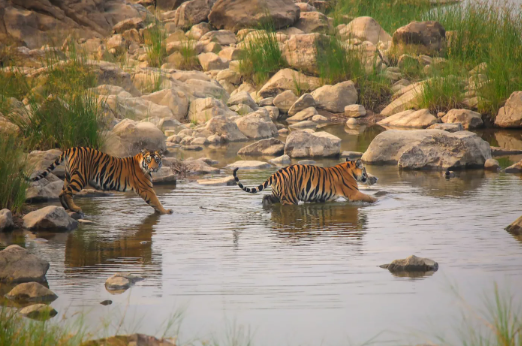
A major concern is the biodiversity loss the project could cause at the Panna Biosphere Reserve. The Panna Tiger Reserve is extremely significant as it holds the Bengal tiger population and has been included in the world network of Biosphere Reserves by the United Nations Educational, Scientific and Cultural Organization (UNESCO). The Panna Tiger Reserve has been in the news for reviving the tiger population from zero in 2009 to 54 in 2019!
A study conducted by the Department of Wildlife Sciences, Aligarh Muslim University, pointed out that the interlinking of the Ken and Betwa rivers would cause a loss of 58.03 square km of critical tiger habitat. Further, the project will also cause an indirect loss of 105 square km due to fragmentation and loss of connectivity, thereby impacting the rich biodiversity in the tiger reserve.
Another environmental concern is the impact of shifting water on atmospheric changes. IIT Bombay conducted research, which found that the interlinking could cause a deficit in rainfall by 12 percent. The research explains that the changing soil moisture in one river basin impacts the neighboring basins, affecting the rainfall patterns.
Lastly, the project would impact the lives and livelihoods of the local population as they would be displaced. As per media reports, 5228 families in Chhatarpur district and 1400 families in Panna district will be displaced due to dam building and the submergence of land.
Land acquisition would also lead to the local communities losing their agricultural land, their primary source of income. Other incomes, including earnings from forest produce, would also be lost.
Durrain Desnavi is pursuing a Masters in Development from Azim Premji University, Bangalore. She is currently a Research Intern with TA.
TA is a Bhopal-based policy and development consulting group. We are on a mission to make the development space more inclusive and democratic for students and professionals. Join us on this mission.